Wind Turbines & The Law Was Upheld In The High Court
PLEASE: Help To Arm People With The Truth & Facts To Make Their Case & Defend Themselves
04-Jun-2016 The Pendulum Swings Against Wind Turbines
&
The Law Was Upheld In The High Court
.
England not windy enough, admits wind industry chief
There are more than 5,000 turbines onshore in the UKCredit: Alamy
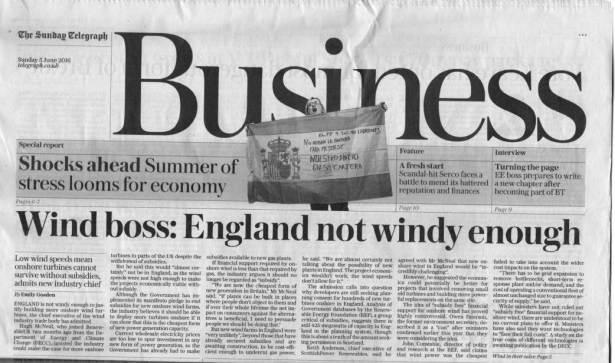
England is not windy enough to justify building any more onshore wind turbines, the chief executive of wind industry trade body has admitted.
Hugh McNeal, who joined RenewableUK two months ago from the Department of Energy and Climate Change, insisted the industry could make the case for more onshore turbines in some parts of the UK, despite the withdrawal of subsidies.
But he said this would “almost certainly” not be in England, as the wind speeds were not high enough to make the projects economically viable without subsidy.
We are almost certainly not talking about the possibility of new plants in England. The project economics wouldn’t work; the wind speeds don’t allow for itHugh McNeal
Although the Government has implemented its manifesto pledge to end subsidies for new onshore wind farms, the industry believes it should be able to deploy more turbines onshore if it can show that this is the cheapest form of new power generation capacity.
Current wholesale electricity prices are too low to spur investment in any new form of power generation, so the Government has already had to make subsidies available to new gas plants.
Hugh McNeal, the new chief executive of RenewableUKCredit: Eddie Mulholland
“We are now the cheapest form of new generation in Britain,” Mr McNeal said. “If plants can be built in places where people don’t object to them and if, as a result of that, over their whole lifetime the net impact on consumers against the alternatives is beneficial, I need to persuade people we should be doing that.”
But new wind farms in England were “very unlikely”, beyond those that have already secured subsidies and are awaiting construction, as they would not be cost-efficient enough to undercut gas power, he said.
“We are almost certainly not talking about the possibility of new plants in England. The project economics wouldn’t work; the wind speeds don’t allow for it.”
The admission calls into question why developers are still seeking planning consent for hundreds of new turbines onshore in England.
Analysis of Government databases by the Renewable Energy Foundation (REF), a group critical of subsidies, suggests there is till 425 megawatts of capacity in England in the planning system – although this is about a tenth of the amount seeking permission in Scotland.
Wind speeds are generally lower in England than other parts of the UKCredit: Getty
Keith Anderson, chief executive of ScottishPower Renewables, said he agreed with Mr McNeal that new onshore wind in England would be “incredibly challenging”.
However, he suggested the economics could potentially be better for projects that involved removing small old turbines and building bigger, more powerful replacements on the same site.
John Constable, REF director, said claims that wind power was the cheapest failed to take into account the wider cost impacts on the system.
“There has to be grid expansion to remove bottlenecks, short term response plant and or demand to cope with errors in the wind forecast, and the cost of operating a conventional fleet of almost unchanged size to guarantee security of supply,” he said.
While ministers have not ruled out “subsidy free” financial support for onshore wind, there are understood to be no current plans to offer it.
Ministers have also said they want ensure technologies have to “face their full costs”. A study on the true costs of different technologies is awaiting publication by the DECC.
Interestingly more or less the same article cropped up in the Business Section on Sunday:
Clearly when we overturned the FoDDC Planning Decision with the Judicial Review, as I had every confidence we would, it would be not just an act of folly for the Council to support an appeal but grossly negligent of public funds.
Further, in the light of the new facts pertaining to Wind Turbines and how grossly inefficient they are, and how damaging they are to both climate and ecology only a selfish self servingindividual would aply for planning for a turbine and surely Lyndon Edwards would not be so desperate for subsidy and so fundamentally dishonest as to make the same application again – unless he really is under the thumb and indebted to the co directors of Ressiliance!
Let us not forget that there was very little genuine support for this costly folly in the first place and we have shown conclusively that not only were the effected community determinedly against the damage but also the reason it was originally passed by FoDDC was that the application was handled by the elected councillors in a manner that was proven to be a corruption of planning law, against the advice of their trained and responsible council officers!
Though it would potentially be libelous to state that the planning committee was corrupt there is no doubt that the High Court decision proved that due process had been corrupted!
There is no doubt in my mind that the applicant Mrs Moira Edwards put herself in a position likely to lead people to believe that her actions were not in the interest of the community she was elected to represent but that she seemed to have stood for election knowing that she was planning to obtain permission to errect a publicly subsidised Wind Turbine, but failed to adequately notify the electorate of this facts and that the company she acted with timed their lengtjh and contentious application su7mmaries to arreve at the very last minute was deeply unpleasant and though I am sure it was within the law to act in sucha manner the ethics of such behaviour was, in my opinion, exceedingly distastefull.
At the end of the day the High Court in its deliberations saw through the pages and pages of unrelated submission and on the point of law Peter Wright’s Coincil led upheld the law, overturning the FoDDC’s flawed planning decision.
When the High Court written judgement is to hand in full it will be published on this web site and let us hope that is the end of this folly and any further efforts to damage this outstandingly beautifull and unique area based upon such devious ignorance, not to mention the failure of the Forest of Dean District Council to accurately represent their constituents and the interests of the area and its people in accord with planning law.
I would like to thank Tidenham Parish Council for their efforts to represent those who elected them and note the failure of Tidenham District Council’s Councillors who did little to uphold the interests of the community going so far, in one instance, to say they would not meet with constituents as he wouldn’t be able to see the Turbine from his home! The position of the MP was also one of largely fence sitting and who did little or nothing to uphold Government policy and the law, regardless of his position as a Government Whip!
My thanks to the serried ranks of those who stood behind us from the immediate area and further afield and those who so generously gave of their time to research, investigate, transcribe and attend the many meetings that were held, also those who contributed financially to assist in the payment of costs along the route to justice – and particularly to Peter and Sue Wright who had the courage of their convictions to take the downside risks of a Judicial Review – am relieved their efforts saw justice done and firmly and accurately done.
IF you note ANY errors of fact in this or any other web site or blog I own please bring it to my attention for correction @ Greg_L-W@BTconnect.com – Thank you.
interestingly to date there has been absolutely no comprehensive Risk Assessment published in the UK regarding the impact in the soil, on the ground and in the air and such assessments that have been done would seem to all have been completed by interested parties likely to commercially or politically gain from the instalation of these undeniable ecological disasters.
With an increasing number of industrial-scale wind turbines around the world, numerous reports are surfacing to suggest that noise, infrasound and stray voltage (dirty energy) may be harmful to livestock and wildlife.
While evidence is largely anecdotal, incidences of mass die-offs of farm animals, chickens laying soft-shelled eggs, high animal miscarriage rates and disappearance of wildlife near turbines provide pause for reflection. These and other incidents suggest a need for scientific study to determine safety before additional wind energy facilities are erected across the U.S., including several proposed in San Diego’s East County.
Although wind turbines have been growing in popularity as an energy alternative in the 21 st century, there has been little to no testing done on the effects that these towering turbines could have on animals or for that matter, humans in the vicinity. We require testing of chemicals to assure safety before they may be used in the environment. Why is similarly rigorous testing not required to date for wind turbines?
This is concerning particularly in East County, which has among the highest number of horses per capita in the U.S. along with other livestock. In addition the region is home to endangered Peninsular Big Horn sheep, rare birds such as the tri-color blackbird, eagles and hawks, mountain lions and other wildlife. Even pets such as dogs and cats potentially could be impacted.
Federal wildlife authorities voice concern over wind impacts on wildlife
There are currently no noise standards for wildlife in the U.S. However the U.S. Fish & Wildlife Service, in a document titled The Effects of Noise on Wildlife, concludes that “although there are few studies specifically focused on the noise effects of wind energy facilities on birds, bats and other wildlife, scientific evidence regarding the effects of other noise sources is widely documented.”
Those impacts include both audible noise and low-frequency infrasound which turbines generate. “It is important to take precautionary measures to ensure that noise impacts at wind facility are thoroughly investigated prior to development,” the USFWS determined.
Declines in some bird species have occurred at noise thresholds as low as 35 decibals (dba), the USFWS notes. Noise levels of 35 to 43 dba have been measured up to a mile from turbines. Closer in, within 300 feet, sound levels of 50 dba have been recorded. Noise can interfere with communications among birds, having an impact “ultimately on avian health and survival,” according to the USFWS report.
Mass animal die-offs
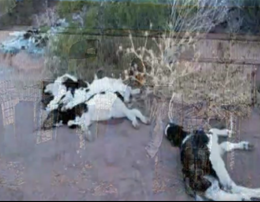
In an article titled Are Wind Turbines Killing Innocent Goats? Discovery Magazine reported that a Taiwanese farmer blames the death of 400 goats on a nearby wind facility. His claim is backed up by a local livestock inspector who said unusual sounds can impact animals’ appetite, growth and sleep. The farmer has stated that the goats had been unable to sleep and began losing weight prior to their deaths.
In Wisconsin, a farmer who tells his story on YouTube describes losing 19 cattle that died or had to be put down because they were “pretty much lifeless.” In addition, 30 calves have died. The farm is within a mile of a wind facility. One cow removed from the site and moved elsewhere later recovered, the farmer stated.
Reproductive problems
An Ontario, Canada goat farmer reported that all 20 of his nanny goats miscarried or had kids that died within hours of birth.
Dr. Nina Pierpont, author of Wind Turbine Syndrome,interviewed a horse breeder who lost six of eight babies after wind turbines were erected nearby his breeding mares. Some aborted early, others had no milk and others didn’t conceive.
“I’ve been in the horse business for 45 years,” the rancher said. “I don’t know whether there’s dirty electricity in the ground, I don’t if they keep them from sleeping…but there’s something.”
If turbines are, in fact, causing miscarriages and other reproductive problems in large animals, what could this mean for the health of pregnant women and women of child-bearing age living in close proximity to the turbines?
The public has no answers, because governments have not required any scientific testing to prove that turbines are safe for humans or animals, despite the proliferation of massive wind projects approved or in the pipeline.
Dr. Nina Pierpont at Johns Hopkin University School of Medicine has concluded that Wind Turbine Syndrome occurs in people as well as in animals. “During my research interviews I collected anecdotal information on animal problems. I heard about moles, deer, dogs, horses, ponies, alpacas, goats, seals, sea eagles (Norway), killdeer, and frogs—all of whom disappeared, behaved abnormally, and/or had observed reproductive failure,” she has written.
It is widely known that bird kills are common when birds collide with whirling turbine blades. Most notoriously, the Altamont wind farm in California has killed thousands of golden eagles, as well as many other birds.
The impacts for bats, however, are even worse. Mass bat die-offs can occur even when bats don’t strike blades, because their lungs explode from the air pressure changes, an article in Current Biology reported in 2008.
In some portions of Wisconsin, Canada and other areas, residents have reported disappearance of wildlife ranging from hummingbirds to crickets to nesting swallows after wind turbines came into the area. Some pet owners have also reported unusual behavior in dogs, such as a reluctance to go outside when turbines are spinning.
Noise impacts on marine mammals
In Germany, a dozen dead porpoises washed ashore near the site of a newly completed wind farm and authorities did not rule out the wind facility as potential causes. Some have suggested that the beaching of 130 dolphins at Cape Cod may be related to wind turbine facilities nearby. At high levels, sound from military sonar has been shown to be fatal to marine mammals, the National Resources Defense Council has reported.
What are the lowest sound thresholds that are safe for whales, porpoises and other marine mammals? More study appears necessary.
Stray voltage
Animals can also be impacted negatively by stray voltage, also known as dirty electricity. Cows living near power lines, for example, have experienced reduced milk production and even been observed “dancing” in fields due to electricity in the ground, according to scientific research presented by experts at the International Conference on Production Diseases in Farm Animals at Michigan State University.
Magda Havas, PhD, has published a provocative article titled “What do Dancing Cows and Zapped Dogs Have in Common?” Havas reports on stray voltage, or ground current, in Toronto, Canada that killed a dog and zapped a child. Cattle have been videotaped “dancing” or lifting hooves repetitively from being shocked by electrical voltage in the ground, Havas reveals.
High ground currents from stray voltage have been measured near multiple wind facilities, including Palm Springs and Campo, California. The latter has had ground currents measured at 1,000 times normal in the Manzanita Indians’ tribal hall and church near a wind facility on a neighboring reservation, according to measurements taken by Dr. Samuel Milham, author of Dirty Energy.
Cumulative observations in some geographic areas
One sheep farmer in Waterloo, Australia had a three-fold spike in birth defects since the turbines started operating. This year, lambs have been born with no ears, three legs and hoofs turned backwards, the Australian newspaper reported. While it’s difficult to know the cause for a handful of birth defects, the fact that they occurred in the same area where chickens have begun laying yolkless eggs and many humans have complained of health problems increases concerns.
A growing number of geographic areas now report animal symptoms overlapping human health complaints after wind turbines are built. Is it all just coincidence?
Conclusion
Mounting anecdotal evidence suggests a need for caution before building wind turbines in areas near wildlife, livestock, and people. While it’s too soon to conclude that turbines have caused the various health problems and fatalities in animals near industrial wind facilities, it is also dangerous to assume that wind turbines are safe for animals or humans living in close proximity.
I try to make every effort to NOT infringe copyrights in any commercial way & make all corrections of fact brought to my attention by an identifiable individual



 interviewed a horse breeder who lost six of eight babies after wind turbines were erected nearby his breeding mares. Some aborted early, others had no milk and others didn’t conceive.
  Chickens near wind farms have been known to lay
 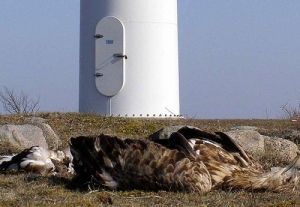 It is widely known that bird kills are common when birds collide with whirling turbine blades. Most notoriously, the Altamont wind farm in California has killed thousands of golden eagles, as well as many other birds.
 Stroat - Wind Turbine